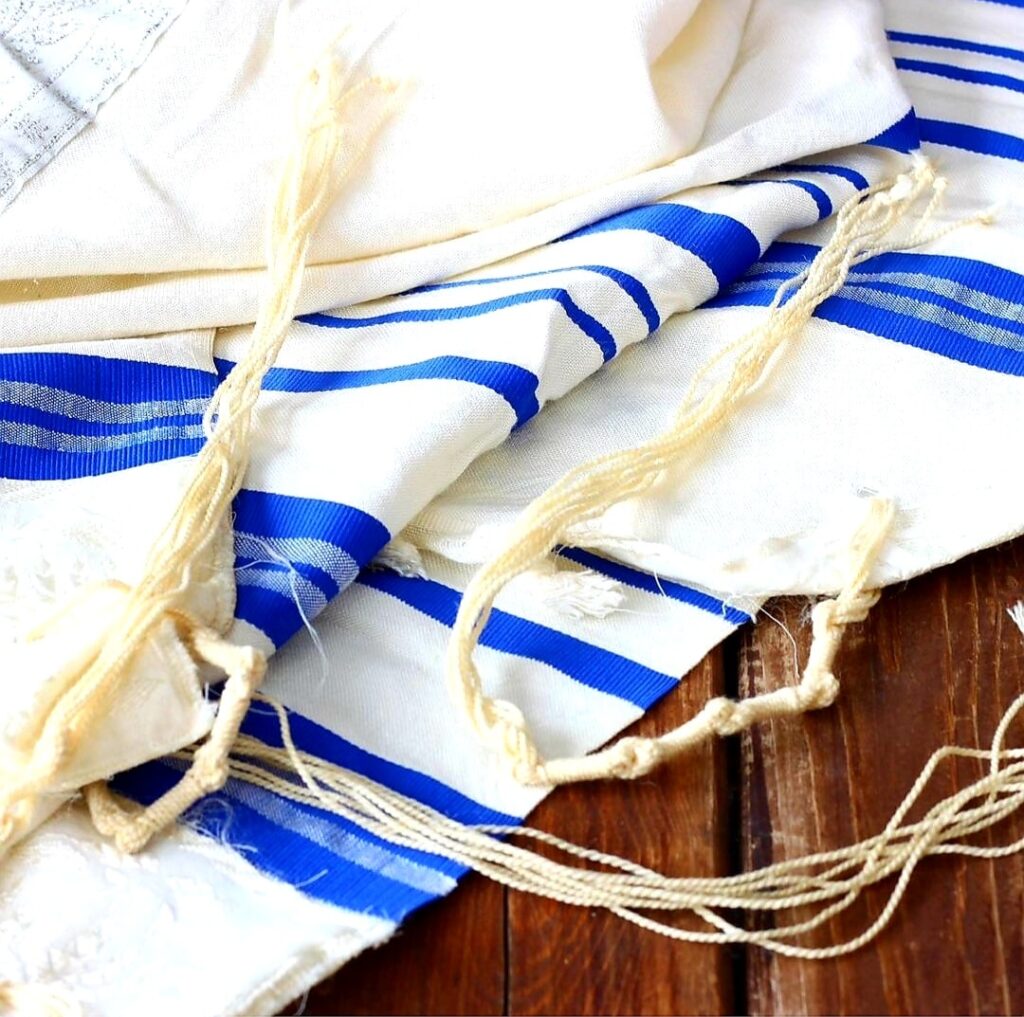
DID YOU KNOW: In Numbers 15, God commanded Moses to instruct the Israelites to make a prayer shawl—white with blue threads—and to wear it as a visible reminder of God’s commands. This garment is known as a tallit.
The most significant part of the tallit is found at its four corners. The corner itself is called the kanaf, and the fringes attached to each corner are called the tzitzit. Each tzitzit is made of eight threads and five double knots, serving as a continual reminder of the 613 commandments and blessings found in the Torah. Every time the wearer looked at or felt the tzitzit, they were reminded to live in obedience to God’s covenant.
The New Testament gives us no physical description of what Jesus looked like, but it does tell us what He wore. Jesus wore garments that included the kanaf and tzitzit, fully obeying the command given in the Torah.
In Matthew 9, we read the account of the woman who had suffered for twelve years and was instantly healed when she touched the hem of Jesus’ garment. This was not a one-time miracle. Scripture records that everyone who touched the hem of His garment was healed.
However, they were not merely touching the bottom edge of His clothing.
The Greek word used in the New Testament for “hem” is kraspedon. This word is a direct translation of the Hebrew kanaf and tzitzit. In other words, they were not touching fabric, they were touching the sacred corner and fringe of His garment. They were reaching out in faith to the visible reminder of God’s covenant promises.
This brings powerful clarity to Malachi 4:2, which declares:
“The Sun of Righteousness shall arise with healing in His wings.”
In Hebrew, the word translated as wings is kanaf—the very same word that means corner of a garment. The verse literally reads:
“The Sun of Righteousness shall arise with healing in His kanaf.”
When people reached for the tzitzit on Jesus’ garment, they were prophetically grabbing hold of the fulfillment of God’s promise, healing in His kanaf. Jesus did not abolish the Torah; He fulfilled it, and power flowed from Him as faith met obedience and covenant.
This is where Scripture comes alive—where Hebrew context brings the Gospel into FULL color.